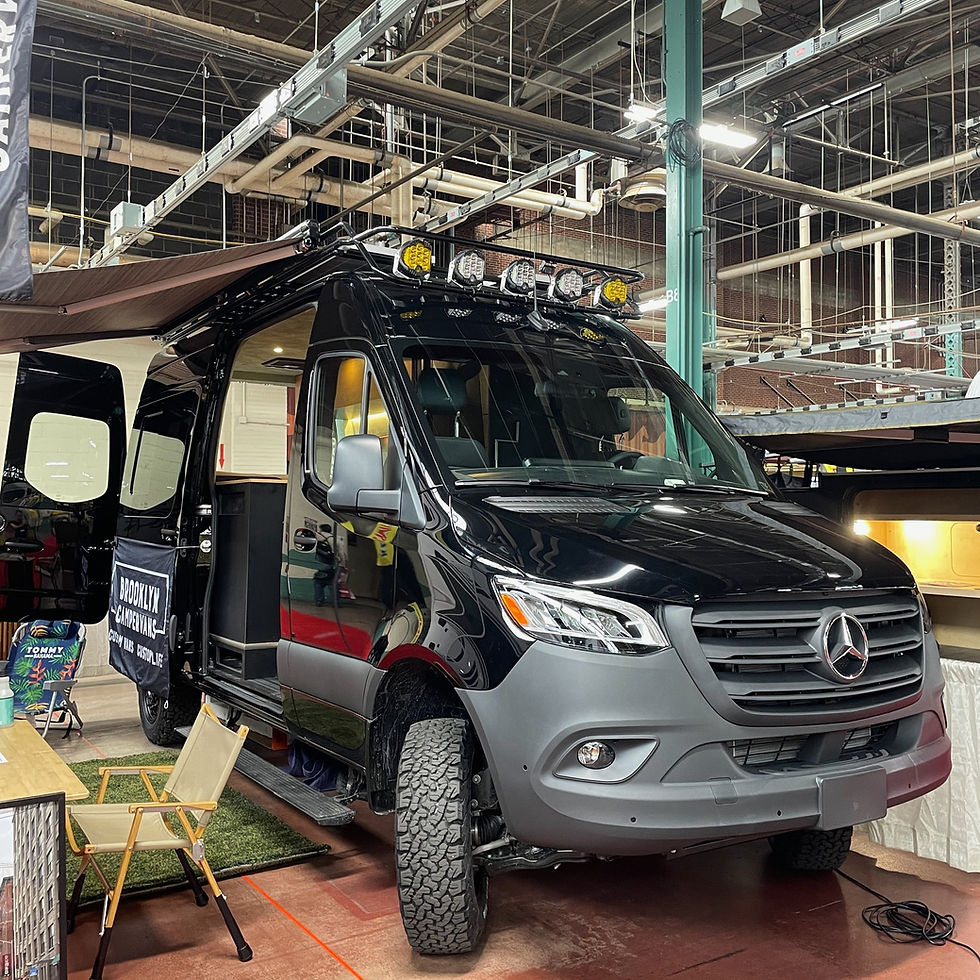
Van Life vs RV: Which One Actually Makes Sense
This comparison gets argued endlessly in online forums. Van people swear by vans. RV people swear by RVs. Neither side is wrong - they're optimizing for different things.
We build custom vans at Brooklyn Camper Vans, so our bias is obvious. But we've also talked to hundreds of people considering both options, and the honest answer is that the right choice depends on how you plan to travel, how much space you need, and what trade-offs you're willing to make.
Here's the real comparison.

Quick Comparison
Factor | Camper Van | Class A/C RV | Travel Trailer |
Price range | $20,000-$270,000 | $60,000-$300,000+ | $15,000-$80,000 |
Monthly fuel | $200-$600 | $400-$1,200 | Tow vehicle dependent |
Monthly insurance | $100-$260 | $150-$400 | $50-$150 + tow vehicle |
Fuel economy | 14-20 MPG | 6-13 MPG | Tow vehicle drops 30-50% |
Sleeping capacity | 2-4 | 4-8 | 4-8 |
Stealth camping | Easy | Difficult | Not practical |
City parking | Standard parking spots | Oversized only | Requires disconnecting the trailer |
Maneuverability | Car-like | Bus-like | Backing requires practice |
Off-road capability | AWD available | Very limited | Limited by tow setup |
Maintenance cost | $1,000-$2,500/year | $2,000-$5,000/year | $500-$1,500/year + tow vehicle |
Where Vans Win
Maneuverability
A Sprinter van is 19-24 feet long, depending on the wheelbase. A Class A motorhome is 30-45 feet. That difference changes everything about how and where you travel.
A van fits in standard parking spots, navigates city streets, drives through fast food lanes, and parks at trailheads where RVs physically can't go. You can drive your van to a restaurant, a grocery store, or a meeting without thinking. In an RV, every destination requires advance planning for parking, turning radius, and overhead clearance.
For van lifers who want to explore cities, access remote camping, and travel without logistical overhead, this advantage alone justifies the smaller living space.
Fuel Costs
A Sprinter diesel gets 16-20 MPG. A Class A motorhome gets 6-10 MPG. A Class C gets 8-14 MPG. Fuel prices fluctuate - at $4.00/gallon diesel, driving 1,500 miles/month costs roughly:
Sprinter: $300-$375
Class A: $600-$1,000
Class C: $430-$750
Over the course of a year, the fuel savings from a van vs. a Class A RV range from $2,700 to $7,500. That's a meaningful chunk of your monthly van life budget.
Stealth and Flexibility
A well-built van doesn't scream "I'm camping here." You can overnight in urban areas, rest stops, and parking lots without drawing attention. An RV announces itself. This matters for free camping, safety, and simply having more options for where you sleep.
Off-Road Access
A Sprinter AWD handles dirt roads, forest service roads, and remote BLM land that RVs can't reach. The best free camping in the western U.S. is on unpaved BLM roads. An RV restricts you to campgrounds and paved pull-offs.
Lower Total Cost
When you factor in fuel, insurance, maintenance, and campsite fees, a van is cheaper to operate month over month. Vehicle operating costs for a van run $460-$1,010/month. A comparable Class A RV runs $1,050-$2,600/month, primarily due to higher fuel costs, more expensive campsite fees, and higher maintenance costs. When you add in all living expenses (food, health insurance, phone, subscriptions), the total cost of van life runs $1,200-$3,000/month vs. $2,000-$4,500/month for a comparable RV lifestyle.

Where RVs Win
Living Space
This is the RV's undeniable advantage. A 35-foot Class A motorhome has 200+ square feet of living space. A Sprinter van has roughly 60-70 square feet. That's the difference between a studio apartment and a one-bedroom.
If you need a separate bedroom, a full kitchen with real counter space, a living room you can walk around in, and a bathroom you don't have to crouch in, an RV delivers. A van requires design creativity to fit those functions into a smaller footprint.
Our Sprinter conversion layouts show how much you can fit into a van with thoughtful design - including a real shower, full kitchen, and dedicated sleeping area - but the square footage is still smaller than any comparably-priced RV.
Sleeping Capacity
A van comfortably sleeps 2 adults (some layouts accommodate 3-4 with bunk configurations). An RV can sleep 6-8 with dedicated bunks, a master bedroom, and a convertible living space. For families with multiple children, the RV provides sleeping options a van can't match.
Built-In Amenities
Mid- to high-end RVs come with residential-size refrigerators, full ovens, washer/dryer combos, multiple TVs, slide-outs that expand the living space, and separate dining areas. A van can have all of these (except slide-outs), but in scaled-down versions.
Resale Simplicity
Used RVs from known manufacturers (Airstream, Winnebago, Grand Design) have a well-established resale market with clear valuation. Custom van builds hold value well but require buyers who understand the conversion market. A custom van from an established builder like ours holds value better than a DIY conversion - but the resale audience is smaller than for an RV.
The Hybrid Option: Travel Trailers
A travel trailer (towed behind a truck or SUV) gives you RV-level living space while keeping your tow vehicle for daily driving. You park the trailer at a campsite and unhitch the truck for errands and exploration.
Pros: Large living space, lower purchase price than motorhomes, and the tow vehicle works as a daily driver.
Cons: Towing reduces fuel economy by 30-50%; backing and parking a trailer require skill; you need a campsite to unhitch (no stealth camping); and a capable tow vehicle adds $30,000-$60,000 to the equation.
For people who move infrequently (staying at one campsite for weeks or months), a travel trailer makes sense. For travelers who move regularly, the towing overhead adds friction that a van eliminates.

Cost Comparison: Van vs RV for Full-Time Living
Upfront Costs
Item | Custom Van (Premium) | Class A RV (Mid-Range) | Travel Trailer + Truck |
Vehicle/unit | $68,000 (Sprinter) | $150,000-$250,000 | $30,000-$60,000 (trailer) |
Build/conversion | $150,000-$200,000 | Included | Included |
Tow vehicle | N/A | N/A | $35,000-$55,000 |
Total | $218,000-$268,000 | $150,000-$250,000 | $65,000-$115,000 |
The van's upfront cost is comparable to or higher than most RVs when you go the custom route. But the startup costs tell only part of the story - ongoing costs flip the equation.
Monthly Operating Costs
Expense | Custom Van | Class A RV | Travel Trailer |
Fuel | $250-$400 | $500-$1,000 | $200-$500 (tow vehicle) |
Insurance | $130-$260 | $200-$400 | $80-$150 + truck |
Campsite fees | $0-$200 | $200-$800 | $200-$800 |
Maintenance | $80-$150 | $150-$400 | $80-$120 + truck |
Monthly total | $460-$1,010 | $1,050-$2,600 | $560-$1,570 |
The van saves $500-$1,500/month in operating costs compared to a Class A RV. Over 5 years, that's $30,000-$90,000 in savings. When you add that to the resale value advantage of a well-built custom van, the total cost of ownership often favors the van despite the higher upfront price.
Who Should Choose a Van
Couples and solo travelers who value mobility and access over square footage
Remote workers who need reliable internet and a functional workspace, not a large one
Adventure travelers who want access to off-road camping, trailheads, and remote areas
City visitors who want to park and explore urban areas without logistical headaches
Budget-conscious full-timers who want the lowest monthly operating cost
People who move frequently - weekly or more often
Who Should Choose an RV
Families with children who need sleeping capacity for 4+
People who stay put - weeks or months at one campsite
Anyone who prioritizes interior space over maneuverability
Full-timers who want residential-level amenities (full oven, washer/dryer, slide-outs)
Retirees who travel at a relaxed pace on established RV routes
Can You Have Both?
Some van lifers start with a van and transition to an RV (or vice versa) as their travel style evolves. Others keep a van for short trips and active travel, and use an RV for extended stationary stays. There's no rule that says you have to pick one forever.
If you're weighing the decision, our recommendation is to start with a van if you're unsure. It's easier to transition from a van to an RV than from an RV to a van. A well-built van teaches you what you actually need (and what you don't) in a way that informs any future RV decision. For a broader look at whether van life suits you, our pros-and-cons guide covers the full picture.

Key Takeaways
Vans win on maneuverability, fuel cost, stealth camping, off-road access, and monthly operating expenses.
RVs win on living space, sleeping capacity, and built-in amenities.
Monthly operating costs are $500- $1,500 lower for vans than for Class A RVs.
A custom van's higher upfront cost is offset by lower operating costs and better resale value over 3-5 years.
Travel trailers offer a middle ground, but add towing complexity and require a capable tow vehicle.
Choose based on how you travel (frequently vs. stationary) and how many people need to live in it.
Frequently Asked Questions
Is van life cheaper than RV life?
Monthly, yes. Vehicle operating costs for a van run $460-$1,010/month; a Class A RV runs $1,050-$2,600/month. When you add in all living expenses, van life totals $1,200-$3,000/month vs. $2,000-$4,500/month for a comparable RV lifestyle. The difference comes from fuel (vans get 2-3x better MPG), campsite fees (vans can free camp more easily), and maintenance. Upfront, a custom van can cost as much as or more than an RV.
Is a van or RV better for full-time living?
It depends on what you prioritize. Vans are better for active travelers who move frequently, want access to remote areas, and prefer lower monthly costs. RVs are better for families, people who stay at one campsite for weeks, and anyone who prioritizes interior space over mobility.
Can you stand up in a camper van?
In a Sprinter High Roof, yes - about 6'3" of finished interior height after the conversion floor and ceiling are installed. The Transit High Roof finishes around 6'5", and the ProMaster around 6'1". Most adults can stand comfortably in any of these. Minivan conversions and low-roof vans do not allow standing. See our best vans guide for height comparisons.
Do vans hold their value better than RVs?
Custom van conversions from established builders hold value well - expect around 70% of total value after 3 years. Mass-market RVs depreciate faster (roughly 35-45% over the first 5 years). Premium RV brands (e.g., Airstream) hold their value better. The key factor is build quality and documentation.
Can a van be as comfortable as an RV?
For 1-2 people, a well-designed custom van with a real shower, full kitchen, climate control, and quality heating is comparably comfortable. The space is smaller, but every square foot is designed for function. For groups of 3+ people, an RV provides comfort that a van can't match.
What's the fuel cost difference between a van and an RV?
A Sprinter at 18 MPG vs. a Class A at 8 MPG, driving 1,500 miles/month at $4.00/gallon: the Sprinter costs about $333/month, the Class A costs about $750/month. That's roughly $400/month or $5,000/year in fuel savings for the van. Actual savings vary with fuel prices - check current diesel prices in your area for a precise estimate.
Can you tow a car behind a van?
Not practically. A Sprinter 2500's towing capacity is 5,000 lbs - enough for a small utility trailer but not a car. Higher-capacity Sprinter models (3500/4500) can tow up to 7,500 lbs, but towing a car behind a van is still uncommon. This is one advantage of larger Class A motorhomes and travel trailers - Class A RVs can tow a small car ("dinghy towing") for use at your destination. With a van, the van IS your daily driver.
Is it easier to maintain a van or an RV?
Vans are simpler mechanically. A Sprinter has one engine, one drivetrain, and standard automotive systems. A Class A motorhome has an engine plus residential systems (generator, slide-out mechanisms, leveling jacks) that each require maintenance. Annual van maintenance costs $1,000-$2,500; RV maintenance runs $2,000-$5,000+.
Can you finance both vans and RVs?
Yes. Both qualify for RV loans if they have sleeping, cooking, and bathroom facilities. Vans and RVs follow similar financing paths - RV loans, personal loans, or home equity. Interest rates and terms are comparable for similar loan amounts.
Which depreciates faster - a van or an RV?
Mass-market RVs depreciate faster than custom vans. A typical Class A motorhome loses roughly 35-45% of its value in the first 5 years. A custom van conversion from an established builder retains about 70% of its value after 3 years. The retention rate depends on the builder's reputation, documentation quality, and overall condition of the build. Schedule a call to discuss how we approach building with long-term value in mind.