
Transit vs Sprinter vs ProMaster: Full Comparison
These are the three vans that dominate the conversion market. Every other vehicle is either smaller (minivans), larger (RVs), or less practical for a full build.
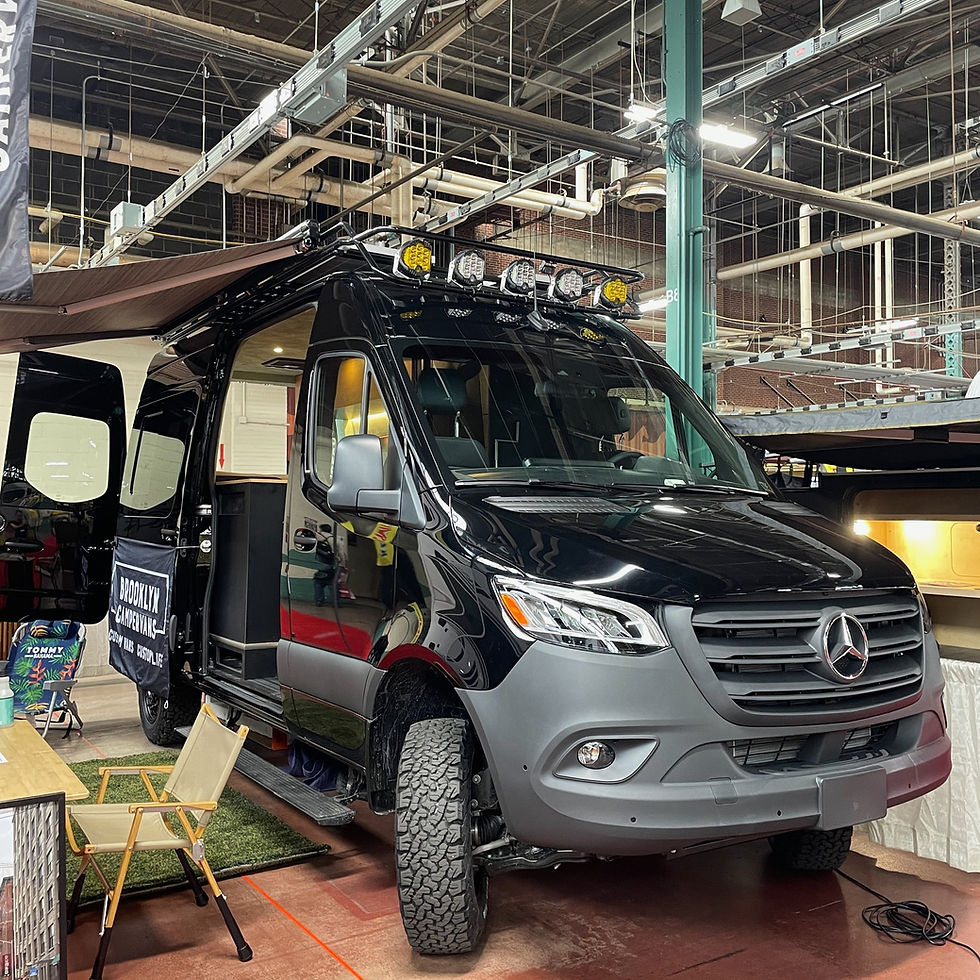
We build exclusively on the Sprinter platform at Brooklyn Camper Vans, so our preference is clear. But we've researched all three extensively, talked to owners of each, and seen clients arrive at our shop after builds on Transits and ProMasters. Here's the honest comparison.

Specs Side by Side
Note: Interior dimensions reflect approximate usable measurements for van conversions, which may differ from factory cargo specs due to roof curvature, wall shape, and measurement methodology. Use these as a comparative reference - verify exact dimensions in person before purchasing.
Specification | Sprinter 170WB HR | Transit 148WB Ext HR | ProMaster 3500 159WB HR |
Interior height | 6'3" (76") | 6'0" (72") | 6'1" (73") |
Interior length | 170" | 148" (extended) | 159" |
Interior width | 70" | 68" | 76" |
Payload capacity | 3,200-4,200 lbs | 3,500-4,600 lbs | 4,000-4,700 lbs |
GVWR | 9,050-11,030 lbs | 9,000-10,360 lbs | 8,900-11,500 lbs |
Engine options | 2.0L diesel, 2.0L gas | 3.5L EcoBoost V6, 3.5L V6 | 3.6L Pentastar V6 |
Fuel economy | 16-20 MPG (diesel) | 14-17 MPG (gas) | 13-16 MPG (gas) |
Drivetrain | RWD, AWD | RWD, AWD | FWD |
MSRP (van life configuration) | ~$62,000-68,000 | ~$48,000 | ~$41,000 |
Used (2019-2023) | $35,000-$55,000 | $22,000-$38,000 | $18,000-$30,000 |
Interior Dimensions: Why They Matter More Than You Think
Height
Three inches doesn't sound like much. But the Sprinter's 6'3" ceiling vs. the Transit's 6'0" is the difference between standing comfortably and feeling the ceiling on every step. If you're 5'10" or taller, the Sprinter gives you headroom for overhead cabinets and still allows comfortable movement. The Transit's ceiling starts to feel tight once you add flooring and insulation (which take up 1-2").
The ProMaster at 6'1" splits the difference - adequate for most people, but the Sprinter has an edge for tall builders who want overhead storage.
Width
The ProMaster is the widest at 76" between the wheel wells. The Sprinter is 70", and the Transit is 68". That extra width in the ProMaster creates a more open feeling and more flexibility in layout design - especially for bed placement.
However, the ProMaster's width comes with FWD wheel wells that intrude slightly into the cargo area at the front of the van. The Sprinter and Transit have rear wheel wells but a flat load floor at the front.
Length
The Sprinter 170WB gives you the most interior length. The Transit Extended 148WB is shorter but still workable for a full conversion. The ProMaster 159WB falls in between.
In practice, all three platforms are long enough for a complete van build with a bedroom, kitchen, and bathroom with a shower. The Sprinter just gives you more room to spread things out, which translates to a more comfortable living experience.
For layout-specific comparisons on the Sprinter, our conversion layout guide shows exactly how we configure the space.

Drivetrain: AWD vs FWD vs RWD
This is one of the biggest practical differences between the three platforms.
Sprinter: AWD or RWD
The Sprinter 170WB AWD is only available in diesel. The AWD system sends power to all four wheels automatically when it detects slip. It's not a hardcore 4x4 system - it won't crawl rocks - but it handles snow, sand, mud, and dirt roads with confidence.
RWD Sprinters (gas or diesel) are fine for paved roads and light gravel. But if you plan to access BLM land, national forest roads, or camp anywhere that's not paved, AWD earns its keep on the first trip.
Transit: AWD or RWD
Ford offers AWD across most Transit configurations. The system is similar to the Sprinter's - automatic engagement when it detects a slip. Performance is comparable. The Transit AWD is a solid choice for all-season van life.
ProMaster: FWD Only
No AWD. No RWD. Front-wheel drive only.
FWD has advantages: better traction in light rain and snow (weight over the drive wheels), tighter turning radius, and a flat cargo floor (no driveshaft tunnel). The ProMaster's turning radius is noticeably better than the Sprinter or Transit - helpful in cities and tight parking lots.
The disadvantage: FWD can't match AWD in loose dirt, deep sand, or significant snow. If you're planning winter van life in mountain areas or accessing unpaved BLM campsites, the ProMaster will be the limiting factor.
Engine and Fuel Economy
Sprinter: Diesel Advantage
The 2.0L OM654 turbo diesel gets 16-20 MPG depending on load and driving style. Diesel engines produce more torque at lower RPMs, which means the Sprinter feels more composed under the weight of a full build than a gas engine does.
Diesel also lasts longer. Sprinter diesel engines routinely reach 300,000-400,000 miles with proper maintenance. Gas engines in Transits and ProMasters are typically done around 200,000-250,000 miles.
The trade-off: diesel fuel costs 10-20% more per gallon than gas, and Sprinter maintenance is more expensive (see maintenance section below). The gas Sprinter option has been available in recent model years, though it's less common in the van life market - check current-year availability with your dealer.
Transit: EcoBoost Power
The 3.5L EcoBoost V6 is a strong engine - 310 hp and 400 lb-ft of torque. It tows well, accelerates with confidence, and has no DEF system to worry about (unlike the Sprinter diesel).
Fuel economy: 14-17 MPG. Adequate but not as efficient as the Sprinter diesel. Over 20,000 miles per year, the Sprinter saves roughly $400-$1,200 in fuel depending on driving conditions and fuel prices, though diesel's higher per-gallon cost narrows the gap.
ProMaster: Budget Workhorse
The 3.6L Pentastar V6 is reliable, parts are cheap, and any mechanic can work on it. It's the simplest and least expensive powertrain of the three.
Fuel economy: 13-16 MPG. The worst of the group, partly because it's a naturally aspirated engine without turbocharging and partly because the ProMaster's blunt aerodynamics don't help at highway speeds.

Maintenance and Service Costs
This is where the Sprinter's premium starts to show.
Maintenance Item | Sprinter (Diesel) | Transit (Gas) | ProMaster (Gas) |
Oil change | $250-$400 | $80-$150 | $80-$130 |
Oil change interval | 10,000-15,000 mi | 7,500-10,000 mi | 8,000-10,000 mi |
Brake job | $600-$1,200 | $400-$800 | $350-$700 |
Transmission service | $400-$600 | $200-$400 | $200-$350 |
Dealer labor rate | $180-$250/hr | $140-$180/hr | $130-$170/hr |
Service network | Mercedes dealers + specialists | Any Ford dealer | Any Ram/Chrysler dealer |
Annual maintenance estimate | $1,500-$3,400 | $940-$1,900 | $850-$1,700 |
Note: Labor rates vary significantly by region. Independent Mercedes-certified shops can bring Sprinter costs down compared to dealer pricing
The Transit wins on service cost and availability. Ford has more dealerships than Mercedes or Ram, and any Ford-trained mechanic can work on a Transit without specialized training. The Sprinter requires Mercedes-specific knowledge, oil specs, and coolant.
That said, the Sprinter's longer service intervals partially offset the higher per-service cost. Two Sprinter oil changes per year at $325 each ($650) vs. three Transit oil changes at $120 each ($360) - the gap is real but narrower than it looks per change.
Resale Value
The Sprinter holds value better than either competitor.
A 2021 Sprinter 170WB HR with 60,000 miles typically sells for 65-75% of its original MSRP. A comparable Transit sells for 55-65%. A ProMaster sells for 45-55%.
On a $200,000+ custom build, that resale difference is significant. A Sprinter-based van with a professional conversion from an established builder can return $150,000-$200,000 after 2-3 years of use, depending on build quality, documentation, and market conditions. A Transit or ProMaster built at the same investment level won't command the same resale price. For the full cost picture, our van life cost guide factors in resale value alongside monthly expenses.
Build Compatibility
All three platforms are buildable, but they're not equally easy to build on.
Sprinter: The most established conversion platform. More aftermarket parts, accessories, and build knowledge available than any other van. Our conversion layouts are designed specifically around the Sprinter's dimensions, mounting points, and electrical systems.
Transit: Good aftermarket support, growing conversion community. The interior curves and panel shapes are slightly more complex to work with than the Sprinter's flatter panels. Overall, a solid build platform.
ProMaster: The flat floor is a genuine advantage for building - no driveshaft tunnel to work around. The wider interior gives more layout flexibility. But the aftermarket parts ecosystem is smaller than for the Sprinter or Transit, and the FWD architecture limits certain build configurations (engine location affects underbody systems).
The Decision Matrix
Your Priority | Best Choice | Why |
Maximum interior space | ProMaster | Widest interior, flat floor |
Best fuel economy | Sprinter diesel | 16-20 MPG, best in class |
Lowest purchase price | ProMaster | $41K new, $18K+ used |
Lowest maintenance cost | ProMaster or Transit | Simple engines, cheap service |
AWD capability | Sprinter or Transit | ProMaster is FWD only |
Best resale value | Sprinter | Holds 65-75% of MSRP |
Largest service network | Transit | Ford dealers everywhere |
Four-season van life | Sprinter AWD | Diesel + AWD + best insulation potential |
Budget build | Transit or ProMaster | Lower vehicle cost, cheaper service |
Premium custom build | Sprinter | Best platform for high-end conversion |
Why We Build on the Sprinter
We're transparent about our choice. The Sprinter costs more to buy and maintain, and we still choose it. Here's why:
Interior height. Those extra inches over the Transit make a daily difference in comfort, overhead storage, and the feeling of the space.
Diesel longevity. A Sprinter diesel engine lasts 300,000-400,000 miles. When you're building a $150,000-$200,000 conversion, you want the base vehicle to last as long as the build.
AWD. Our clients travel year-round, including winter. AWD is available on the Sprinter diesel in the 170WB - the exact configuration we build on.
Resale value. A well-documented Sprinter custom build holds value in a way that supports the investment. Our clients who sell after 2-3 years recoup a significant portion of their total spend.
Ecosystem build. We've refined our build process over 80+ Sprinter conversions. Every mounting point, electrical routing, insulation method, and system integration is optimized for this platform.
For clients where budget is the primary driver and they plan shorter-term van life (1-3 years), we'll honestly point them toward a Transit or ProMaster. The right platform depends on the person and the plan.
Key Takeaways
The Sprinter wins on height, fuel economy, AWD, diesel longevity, and resale value.
The Transit wins on price, maintenance cost, and service availability.
The ProMaster wins in interior width, payload, purchase price, and flat-floor simplicity.
For premium full-time builds, the Sprinter's advantages justify the higher cost.
For budget builds or shorter-term van life, the Transit offers the best value.
FWD-only (ProMaster) limits access to off-road camping and winter capability.
Frequently Asked Questions
Which van is best for a camper conversion?
The Mercedes Sprinter 170WB High Roof AWD is the best overall platform for a full-time camper conversion. It offers the most interior height (6'3"), AWD capability, diesel efficiency, and the strongest resale value. The Ford Transit is the best value option, and the Ram ProMaster is the most affordable entry point.
Is the Sprinter worth the extra cost?
For full-time van life and premium builds, yes. The extra $14,000-$20,000 over a Transit (or up to $27,000 over a ProMaster) is offset by better fuel economy, stronger resale value (retaining 10-20% more value than competitors), and a diesel engine that lasts 100,000+ miles longer. For short-term or budget van life, the Transit or ProMaster offers better value.
Which van gets the best gas mileage?
The Sprinter diesel at 16-20 MPG. The Transit gas engine gets 14-17 MPG. The ProMaster gets 13-16 MPG. Over 20,000 miles per year, the Sprinter's efficiency advantage translates to meaningful fuel savings, though diesel's higher per-gallon cost partially offsets the MPG gap.
Can you get AWD on all three vans?
No. The Sprinter and Transit offer AWD. The ProMaster is front-wheel drive only. If you want AWD for winter travel, off-road camping, or accessing unpaved BLM land, the ProMaster is out. The Sprinter AWD is diesel-only in the 170WB configuration.
Which van is cheapest to maintain?
The ProMaster, followed closely by the Transit. Both use simple gas engines with parts available at any auto parts store. The Sprinter diesel requires Mercedes-specific oil, coolant, and DEF, with labor rates 20-50% higher at Mercedes dealers. Annual maintenance on a ProMaster runs $850-$1,700 vs. $1,500-$3,400 for a Sprinter.
Which van has the most cargo space?
The ProMaster 159WB has the widest interior (76") and a completely flat floor. The Sprinter 170WB has the most interior length. For total cargo volume, the Sprinter 170WB and ProMaster 159WB are comparable - around 370-400 cubic feet before conversion. The Transit Extended 148WB offers slightly less at roughly 350 cubic feet.
How long do these vans last?
Sprinter diesel engines routinely reach 300,000-400,000 miles. The Transit EcoBoost and ProMaster Pentastar engines typically last 200,000-250,000 miles. For a van you're investing $100,000+ into converting, the Sprinter's engine longevity is a significant factor.
Which van is easiest to drive?
The ProMaster has the tightest turning radius and feels most car-like in city driving. The Transit drives smoothly and predictably. The Sprinter is slightly larger but handles well for its size, especially the AWD model on loose surfaces. All three are significantly easier to drive than any RV. See our van life vs RV comparison for that distinction.
Can you build a bathroom in all three vans?
Yes. All three platforms have enough interior space for a full wet bath with shower, toilet, and sink. The Sprinter's extra length gives the bathroom area slightly more room to work with, which makes the difference between a functional shower and a comfortable one.
Which van should I buy for van life?
If budget allows and you plan to live in it full-time: Sprinter 170WB HR AWD (diesel). If you need to keep costs down and want excellent value, choose the Transit 148WB Extended HR (AWD). If you want the cheapest entry and don't need AWD: ProMaster 3500 159WB HR. Schedule a call with us, and we'll help you choose based on your specific travel plans, budget, and timeline.


