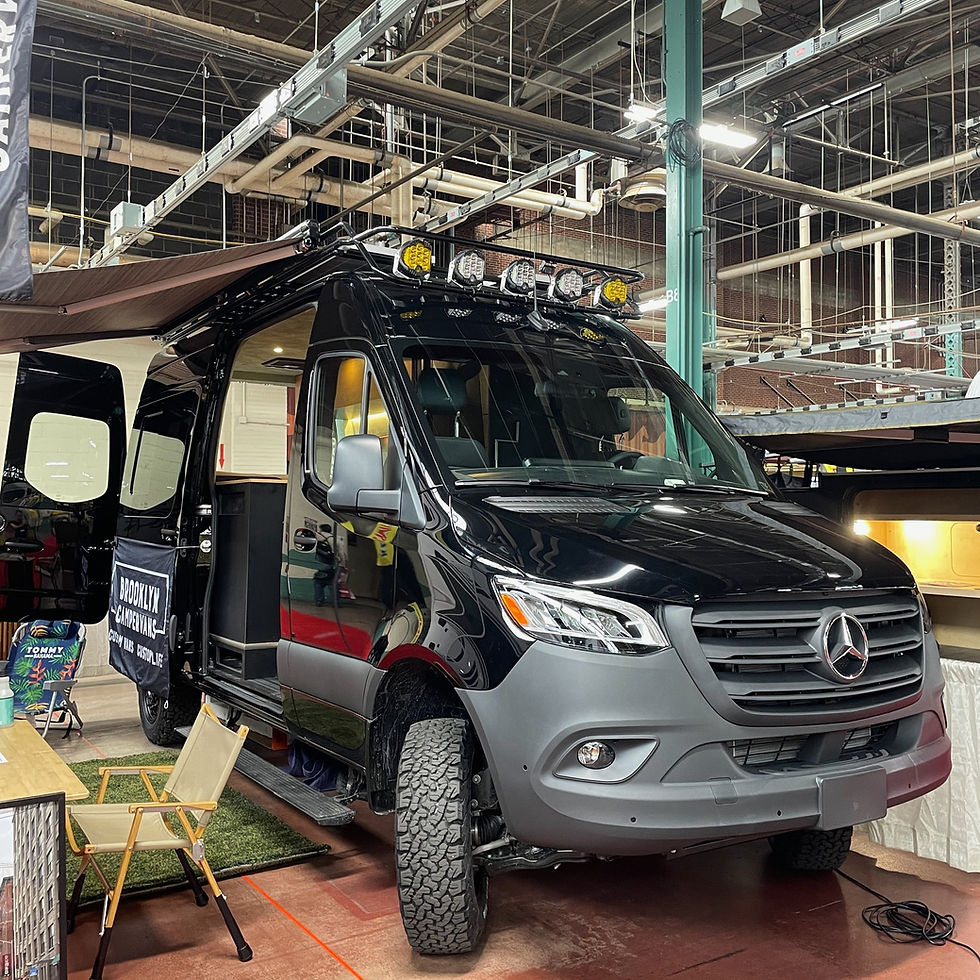
Camper Van Heating: Systems That Actually Work
Heating is the system that separates a three-season van from a four-season home. Get it wrong, and you'll be sleeping in a sleeping bag at 40°F, wondering why you spent six figures on a van. Get it right, and January in Colorado feels the same as October.
We've tested every major heating option across 80+ builds at Brooklyn Camper Vans. Here's what works, what doesn't, and why we chose the system we did.

Camper Van Heating Options
1. Diesel Air Heaters (What We Install)
A diesel air heater draws fuel from your van's tank, burns a small amount of diesel, and blows heated air into the living space. Combustion gases are vented outside through an exhaust pipe: no fumes, no moisture, no carbon monoxide inside the van.
Webasto EVO 40
This is what we install in builds spec'd for serious cold-weather or high-altitude use - it's the upgrade from our standard Air Top 2000 STC. The Webasto EVO 40 is the standard for professional van conversions, and here's why:
Output: 13,600 BTU - enough to heat a Sprinter interior from freezing to 70F in about 15 minutes
Altitude rated: Functions up to 18,000 ft with the altitude kit (which we install for clients planning mountain travel). This matters if you're camping in the Rockies, Sierras, or anywhere above 5,000 ft, where cheaper heaters lose performance.
Fuel consumption: 0.06-0.14 gallons/hour. On a 50-gallon diesel tank, that's hundreds of hours of heat before you notice it on the fuel gauge.
Smart thermostat: Set your target temperature, and the heater cycles automatically. Set it to 62F at night and sleep comfortably regardless of outside conditions.
Battery draw: 15-55W while running. Minimal impact on your solar and battery system.
Installed cost: Roughly $3,100, including the heater, thermostat controller, fuel line, exhaust, and professional installation.
Webasto STC 2000
A slightly smaller unit at roughly 6,800 BTU. Better suited for smaller vans or mild-winter use. Lower fuel consumption and quieter operation, but it won't heat a Sprinter as fast or effectively in deep cold. Installation cost: $2,400-$2,800.

Chinese Diesel Heaters (The Budget Option)
You'll find 5kW diesel heaters on Amazon for $150-$300. Brands like VEVOR, Hcalory, and generic units are everywhere in the van life community.
The honest assessment: they work. A 5kW Chinese diesel heater produces adequate heat for a Sprinter. Many van lifers use them for years without problems.
The trade-offs:
Reliability. Failure rates are higher than those of Webasto or Espar units. A heater that fails at 2 AM in February isn't just an inconvenience - it's a safety issue.
Noise. Most Chinese units are noticeably louder than the Webasto, especially at startup. The ticking and whirring can be heard from outside the van (stealth camping concern) and from the bed.
Altitude performance. Most Chinese heaters aren't altitude-rated. Above 5,000 ft, combustion efficiency drops, leading to incomplete burns, soot buildup, and potential carbon monoxide issues.
No certification. Webasto heaters are tested and certified to automotive standards. Chinese heaters are not. For insurance purposes, an uncertified heater installation could affect your coverage if it causes a fire.
Warranty. Webasto offers a 2-year warranty with a certified installer network. Chinese heaters offer the Amazon return window.
For a budget build, a Chinese diesel heater is a reasonable choice. For a build you're investing $100,000+ in, the Webasto's reliability and certification are worth the $2,500 premium.
2. Propane Heaters
Propane heaters are common in RVs and older van builds. They produce heat by burning propane from a dedicated tank.
Propex HS2000
The most popular propane heater for van conversions. 6,500 BTU output, forced-air design with external exhaust. Installation cost: $800-$1,200.
The problems with propane in a van:
Moisture production. Propane combustion produces water vapor as a byproduct. In a 60-square-foot van, moisture condenses on windows, walls, and surfaces, accelerating mold and corrosion. This is the opposite of what you want, especially in winter.
Separate fuel supply. You need to carry a propane tank (20-30 lbs for a standard portable), find refill locations, and manage a second fuel system. Diesel heaters use fuel that's already in your van's tank.
Weight and space. A propane tank takes up storage space and adds weight. In a van where every pound matters for payload, this is a real trade-off.
Safety concerns. Propane is heavier than air - a leak pools at floor level. CO detectors and propane detectors are mandatory if you run propane. The risk is manageable with proper installation and detectors, but the risk profile is higher than a diesel system that vents externally.
Propane heaters make sense for gas-powered vans (Transit, ProMaster) that don't have a diesel fuel supply. For diesel Sprinters, a diesel heater is the obvious choice since you're already carrying the fuel.
3. Electric Heating
Electric heating in a van comes in a few forms: ceramic space heaters, heated blankets, and heat pump systems.
Ceramic space heaters: A 1,500W ceramic heater draws heavily on your battery. Running one for 8 hours overnight consumes 12 kWh - that's your entire battery bank on a 15 kWh system, and it exceeds the capacity of smaller setups. Electric space heaters work if you're plugged into shore power at a campground. Off-grid, they're not viable as a primary heat source.
Heated blankets and mattress pads: 50-100W draw. These are supplemental, not primary. A heated mattress pad at 75W keeps you warm while sleeping for a fraction of the energy cost of heating the entire van. We recommend these as a comfort addition alongside a diesel heater, not a replacement.
Heat pumps (mini-split style): Some builds incorporate mini-split heat pump systems that provide both heating and cooling. These are efficient in moderate climates (40-70F) but lose effectiveness below 30F. In a van context, they add complexity, weight, and cost ($3,000-$6,000 installed). They make sense in builds designed for warm-climate travel with occasional cool nights - not for true four-season van life.

4. Engine Coolant Heaters (Hydronic)
Hydronic heaters (like the Webasto Thermo Top) heat engine coolant, which then circulates through a heat exchanger to warm the living space. These are common in commercial vehicles and cold-climate applications.
Advantages: They pre-heat the engine (easier cold starts, faster cabin heat from the vehicle's own system), and they don't blow air directly (quieter operation).
Disadvantages: More complex installation, higher cost ($4,000-$6,000 installed), and the need for a coolant loop plumbed into your living space. For most van lifers, the simpler diesel air heater achieves the same result with less complexity.
The Insulation Factor
No heating system compensates for poor insulation. A Webasto running constantly in a van with rigid foam board and gaps in the insulation will struggle to maintain 65F when it's 20F outside - and your battery and fuel costs will be higher than necessary.
Proper insulation means:
Rock wool at R-15 in the walls (roughly 4 inches). Rock wool doesn't absorb moisture, doesn't support mold growth, and maintains its R-value even when damp.
Sheep wool on walls and ceilings for moisture management. Sheep wool absorbs excess moisture from the air and releases it when conditions dry out - acting as a passive humidity controller.
Insulated window coverings for every window. Windows are the biggest thermal weak point. Custom-fit insulated blackout covers can raise the interior temperature by 10-15F compared to bare windows.
We've tested insulation performance by parking vans in the NYC sun in August and measuring interior temperatures every 30 minutes. The insulation system we use maintains a 20-30F differential from outside temperature without any active heating or cooling. That means your heater works less, your battery lasts longer, and your diesel consumption stays low.
For the complete winter preparation checklist, see our winter van life guide, which covers insulation, heating, condensation management, and winter driving.
Monthly Heating Costs
System | Fuel/Energy Cost | Annual Maintenance | Notes |
Webasto EVO 40 (diesel) | $30-$100/month (winter) | $50-$100 | Uses the van's diesel tank |
Chinese diesel heater | $30-$100/month (winter) | $50-$100 | Same fuel, less reliability |
Propex propane | $40-$100/month (winter) | $30-$50 | Propane refill costs vary by region |
Electric space heater | $0 (shore power) / high battery drain (off-grid) | Minimal | Only practical on shore power |
Heated blanket (supplemental) | $5-$15/month battery draw | None | Not a primary heat source |
Heating costs are seasonal. From June through September, most van lifers in temperate climates spend nothing on heating. November through March, budget $30-$100/month for fuel. This is factored into the monthly cost breakdown.

How We Install Heating in Our Builds
Our heating installation process on every build includes:
Placement: The Webasto unit is mounted under the van or in a dedicated compartment that vents externally. The fuel line taps into the van's diesel tank via a dedicated fuel pickup. The exhaust pipe routes underneath and exits away from any air intakes.
Thermostat location: Digital thermostat controller mounted at eye level in the living area. Set your target temp, and the system maintains it automatically.
Ducting: Heated air is distributed through ducting to reach both the living area and the bedroom. A single-point heater output creates hot and cold zones - proper ducting eliminates that.
Integration with monitoring: The EcoFlow app shows real-time power consumption, including the heater's draw. Combined with Starlink connectivity, you can monitor interior temperature remotely - critical for pet safety if you step away from the van.
Backup: In our builds, the insulation is sufficient that even with the heater off, the van maintains livable temperatures down to roughly 40°F outside. The heated mattress pad provides personal warmth as a secondary layer of comfort.
Key Takeaways
Diesel air heaters (Webasto EVO 40) are the gold standard for van heating - reliable, efficient, and they don't produce interior moisture.
The Webasto EVO 40 costs roughly $3,100 installed and uses 0.06-0.14 gallons of diesel per hour
Chinese diesel heaters are budget-friendly but trade reliability, certification, and altitude performance for a lower price.
Propane heaters produce moisture inside the van - a major problem for condensation and mold in small spaces.
Electric heating is not viable off-grid as a primary heat source - the battery draw is too high.
Proper insulation (R-15 rock wool + sheep wool) is the foundation for any heating system to work efficiently.
Budget $30-$100/month for heating fuel during the winter months.
Frequently Asked Questions
What is the best heater for a camper van?
The Webasto EVO 40 diesel air heater is the best option for most van builds. It produces 13,600 BTU (enough to heat a Sprinter in 15 minutes), runs on your van's diesel tank, vents all combustion gases outside, and draws minimal battery power. It's altitude-rated to 18,000 ft and comes with a 2-year warranty.
How much does a van heater cost to install?
A Webasto EVO 40 costs roughly $3,100 fully installed. A Chinese diesel heater costs $150-$300 for the unit plus $100-$300 for installation materials. A Propex propane heater costs $800-$1,200 installed. The price difference between Webasto and budget options reflects certification, reliability, and warranty coverage.
Are Chinese diesel heaters safe?
They can be safe when installed correctly with proper exhaust venting and a CO detector. The risk is higher than with certified Webasto or Espar units because Chinese heaters aren't tested to automotive safety standards. Altitude performance is the biggest concern - incomplete combustion at elevation can produce carbon monoxide. For any installation, a hard-wired CO detector is non-negotiable.
Can you heat a van with solar power?
Not directly with electric heating - the draw is too high. A 1,500W space heater running 8 hours consumes 12 kWh, which would drain most battery systems. Solar does power the control systems and fans in a diesel heater (10-30W draw). The practical answer: solar powers your overall electrical system, and a diesel heater handles the actual heating.
How cold can you camp in a van?
With a Webasto heater and proper insulation, there's no practical temperature limit. Our clients camp comfortably in single-digit temperatures. The Webasto is rated to -40F. The limiting factor is usually driving conditions, not heating capability. See our winter van life guide for the full cold-weather setup.
Does a diesel heater use a lot of fuel?
No. The Webasto EVO 40 consumes 0.06-0.14 gallons per hour. Running the heater 12 hours overnight at medium output uses roughly 1 gallon of diesel ($3.50-$4.00). On a 50-gallon tank, a week of overnight heating barely registers on the fuel gauge.
Should I get propane or diesel heating?
Diesel if you drive a diesel van (Sprinter). You already carry the fuel, the system is simpler, and diesel combustion doesn't produce moisture inside the van. Propane if you drive a gas van (Transit, ProMaster) and don't want to add a separate diesel fuel supply. The moisture issue with propane is manageable with proper ventilation, but it adds a maintenance consideration.
How do you prevent condensation with a heater?
Use a diesel heater (not propane) to avoid adding moisture from combustion. Run your exhaust fan on low while the heater runs. Use insulated window coverings. Keep interior temperature consistent overnight - temperature drops push moisture to the dew point and cause condensation. Sheep wool insulation helps absorb and passively regulate excess humidity.
Do you need a heater for van life?
Yes, especially if you plan to travel across most of the U.S. between October and April (or year-round at elevation). Even mild climates - Southern California, the Gulf Coast - drop into the 40s-50s at night during winter. A dedicated heater is the difference between comfortable sleep and a miserable night. It's one of the van life essentials we recommend for every build.
Can you run a van heater while sleeping?
Yes. Diesel air heaters with external exhaust are designed to run overnight. Set the thermostat to your target temperature, and the heater cycles automatically. A CO detector is mandatory regardless. The Webasto's thermostat-controlled operation means it doesn't run continuously - it cycles on when the temp drops below your target and off when it reaches it, minimizing fuel and battery use.
How do van lifers with dogs keep pets warm?
The same heating system that keeps you warm keeps your pet warm. The bigger concern is temperature monitoring when you're away from the van. Our builds include remote temperature monitoring through the EcoFlow app and Starlink connection - you can check the interior temperature from your phone and get alerts if it drops below a set threshold. That's pet safety that works whether you're 5 minutes or 5 hours away. Schedule a call, and we'll walk through the climate control setup for your specific situation.