Best Solar Setup for Van Life in 2026
Solar is what makes off-grid van life possible. Without it, you're either running your engine to charge your batteries, paying for campgrounds with hookups, or carrying a loud, heavy generator that burns fuel.
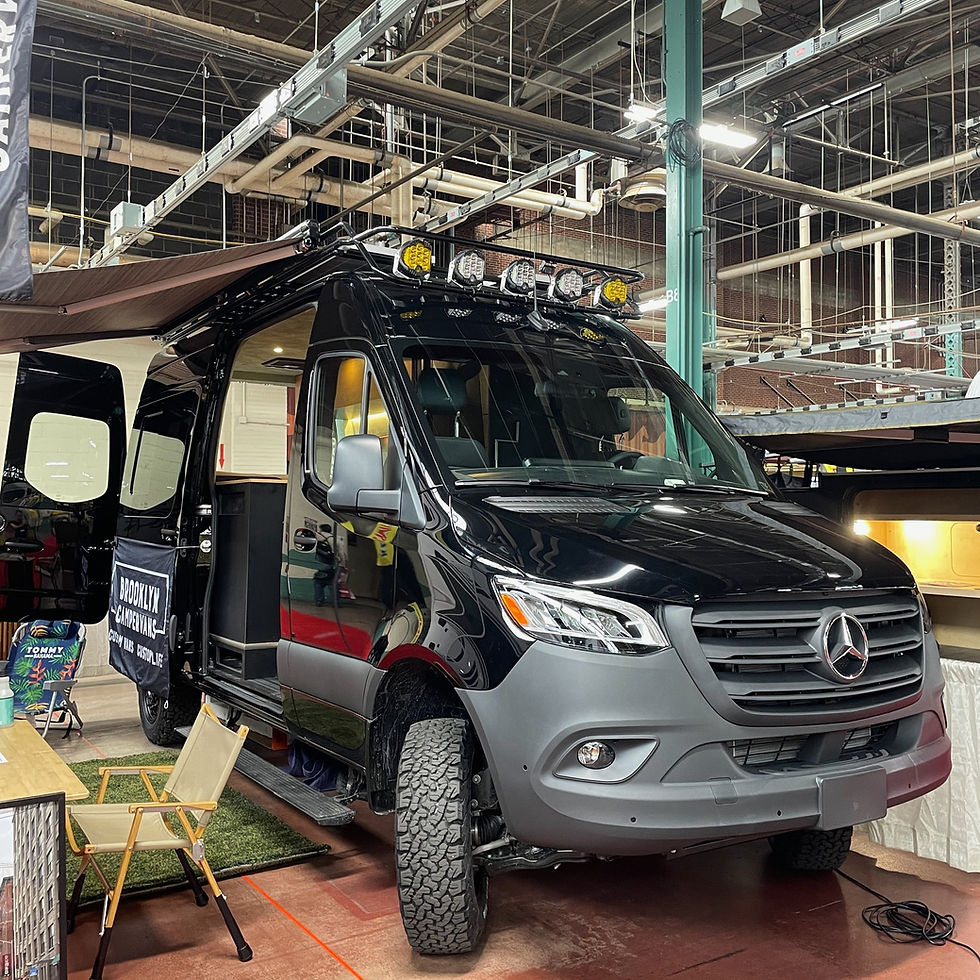
We've installed solar on 80+ van builds at Brooklyn Camper Vans and tested nearly every available panel, charge controller, and mounting configuration. Here's what actually works, what's overkill, and how to size a system for your specific power needs.

How Van Life Solar Works
The concept is simple. Solar panels on your roof convert sunlight into DC electricity. A charge controller regulates that power and feeds it into your battery bank. Your battery stores the energy and powers everything in your van - lights, fridge, fans, Starlink, induction cooktop, and anything else you plug in.
The system has four main components: panels, a charge controller, a battery, and an inverter (which converts DC to AC for household electronics). Getting the sizing right across all four is what separates a system that works from one that leaves you dead in a campground.
How Much Solar Do You Need?
This depends entirely on what you're running. Here's a realistic power budget for a full-time van lifer:
Device | Watts | Hours/Day | Wh/Day |
Dometic fridge | 45 | 24 (cycling) | ~400 |
Starlink Gen 3 (12V mod) | 30-50 | 8-12 | 300-600 |
MaxxAir fan | 5-40 | 8-16 | 80-300 |
LED lighting | 10-30 | 4-6 | 60-180 |
Laptop charging | 60 | 4-6 | 240-360 |
Phone charging | 15 | 2 | 30 |
Induction cooktop | 1,800 | 0.5 | 900 |
Webasto heater controller | 10-30 | 8 (winter) | 80-240 |
Total daily draw: 1,500-3,000 Wh (1.5-3 kWh)
A typical full-timer with a fridge, Starlink, laptop, and cooking uses about 2,000-2,500 Wh per day. A couple running everything plus AC in summer can push 4,000+ Wh.
Sizing Your Panels
A 100W solar panel produces roughly 400-500 Wh per day in full sun (assuming 4-5 peak sun hours and accounting for system losses from wiring, charge controller efficiency, and panel temperature). So:
200W of solar: Covers a minimalist setup - fridge, lights, phone charging. Not enough for Starlink and laptop work.
400W of solar: Covers most solo van lifers who run a fridge, Starlink, a laptop, and basic electronics. Tight in winter or cloudy conditions.
Up to ~595W of solar: Covers couples, heavy users, and anyone who wants a comfortable margin. Our solar upgrade tops out at 595W on walkable panels mounted to an Unaka roof rack.
We install up to 595W of walkable solar panels on an Unaka roof rack. Walkable panels are a key feature - they're integrated into the roof surface so you can step on them while accessing the Starlink dish, roof rack storage, or the solar deck area on our Elevate Van layout.

Best Solar Panels for Van Life
Rigid Panels
Rigid monocrystalline panels are the standard for permanent van installations. They're the most efficient per square foot (20-22% for current production panels), durable, and last 25+ years.
The downside is weight and mounting. Rigid panels require a roof rack or mounting brackets and add height to your van. On a Sprinter High Roof, every inch of height matters for parking garages and low-clearance areas.
Our recommendation: Rigid panels mounted on an Unaka roof rack. The rack provides a low-profile mounting platform that keeps panels close to the roof, includes a wind fairing, and doubles as cargo/access space.
Flexible Panels
Flexible panels can be adhered directly to the roof, keeping the profile low. They're lighter and easier to install. But they degrade faster (5-10 year lifespan vs. 25+ for rigid), they're less efficient (15-18%), and they can overheat when mounted flush against the roof without airflow underneath.
We don't use flexible panels. The shorter lifespan and lower efficiency don't justify the profile savings for a build designed to last.
Walkable Panels
These are rigid panels built to withstand foot traffic. We use them because they integrate into the roof deck, allowing you to walk on them while accessing other roof-mounted equipment. They're slightly less efficient than standard rigid panels due to the reinforced surface, but the practical benefit of a usable roof deck outweighs the small efficiency loss.
Battery Systems: Matching Storage to Solar
Solar panels are only useful if you have somewhere to store the energy. Your battery bank is the foundation - panels charge it during the day, and you draw from it 24/7.
EcoFlow Power Kit (What We Install)
We've been using EcoFlow Power Kit systems for four years across all of our builds. The system is modular - you can start with a smaller battery and expand capacity later by adding battery modules.
Why we chose it:
Smart monitoring app. You can see real-time power production, consumption, and battery state of charge from your phone. Paired with Starlink, you can monitor remotely from anywhere.
Multiple input sources. Solar, shore power, alternator charging, and generator - all managed automatically. The system prioritizes solar and switches to other sources as needed.
5-year warranty. If something fails in the field, you're covered. Compare that to DIY electrical builds with no warranty and no support line.
Plug-and-play expansion. Adding capacity later doesn't require rewiring the whole system.
How Much Battery Do You Need?
The rule: your battery capacity should cover at least 1.5-2 days of power use without any solar input. That accounts for cloudy days and winter solar reduction.
2 kWh: Weekenders and minimal setups. Not enough for full-time van life.
5 kWh: Covers most solo full-timers. Provides a 2-day buffer with average usage of 2-2.5 kWh/day.
10 kWh: Comfortable for couples or heavy users. Handles AC usage and multi-day cloudy stretches.
15 kWh: Maximum independence. Run everything, including AC, and never worry about power. This is what we install in builds where clients want to spend weeks off-grid without compromise.

Charge Controllers: MPPT vs. PWM
The charge controller sits between your solar panels and battery. It regulates the voltage and current to charge your battery efficiently and safely.
MPPT (Maximum Power Point Tracking) controllers are the standard for van builds. They convert excess panel voltage into additional charging current, which makes them 15-30% more efficient than PWM controllers. In practical terms, an MPPT controller gets more usable energy out of your panels - especially in partial shade or non-ideal conditions.
PWM (Pulse Width Modulation) controllers are cheaper but less efficient. They're fine for a basic setup with a single small panel, but for any system above 200W, MPPT pays for itself through better energy harvest.
The EcoFlow Power Kit includes an integrated MPPT charge controller, so if you're using their system, this is handled.
Inverters: DC to AC Conversion
Your battery stores DC power. Most household electronics (laptops, blenders, Instant Pot, hair dryers) run on AC. The inverter converts DC to AC.
Pure Sine Wave vs. Modified Sine Wave
Always go pure sine wave. Modified sine wave inverters are cheaper but produce a choppy power signal that can damage sensitive electronics (laptops, phone chargers, medical devices) and make some devices buzz or run hot. A pure sine wave produces clean power identical to that from a wall outlet.
The EcoFlow Power Hub includes a built-in pure sine wave inverter rated at 2,600W continuous (5,200W surge). That's enough to run an induction cooktop on both burners, or a microwave plus a few smaller devices - though high-draw appliances should be staggered rather than run simultaneously.
Alternator Charging: Your Solar Backup
Solar alone doesn't cover every situation. On cloudy days, in winter, or when you're driving anyway, alternator charging supplements your solar production.
A secondary alternator or a DC-DC charger pulls power from your van's engine alternator while you're driving and feeds it to your house battery. Depending on your setup, you can add 600-1,200 Wh to your battery bank per hour of driving. A 2-3-hour drive can put a meaningful dent in recharging - enough to fully top up a 5 kWh battery or add a solid day's worth of buffer to a larger bank.
We install alternator charging as standard on newer builds. Combined with 600-700W of solar, you're covered in virtually every scenario short of a week of solid overcast while parked.
The EcoFlow Smart Generator: Backup Power
For the rare scenario where solar is insufficient, and you can't drive - extended overcast weather, winter in the Pacific Northwest, or running AC in a heat wave - the EcoFlow Smart Generator provides a backup.
It automatically senses when your battery drops below a set threshold and charges it back up. We mount it in a sound-insulated box to minimize noise. It runs on gas and burns about 0.5 gallons per hour while charging.
Most of our clients rarely use the generator. But having it means you never have to worry about running out of power in a critical situation - especially if you're working remotely and a dead battery means a missed deadline.

What Does a Van Solar Setup Cost?
Component | Budget | Mid-Range | Premium (What We Install) |
Solar panels | $200-$400 (200W) | $500-$900 (400W) | $1,000-$1,500 (600-700W walkable) |
Charge controller | $80-$150 (PWM) | $200-$400 (MPPT) | Included in EcoFlow |
Battery | $800-$1,500 (2 kWh) | $2,000-$4,000 (5 kWh) | $5,000-$12,000 (10-15 kWh) |
Inverter | $150-$300 | $400-$800 | Included in EcoFlow |
Wiring/installation | $200-$500 (DIY) | $1,000-$2,000 | Included in build |
Roof rack/mounting | $300-$600 | $800-$1,500 | $1,500-$2,500 (Unaka) |
Total | $1,730-$3,450 | $4,900-$9,600 | $8,500-$19,500 |
The premium setup costs more upfront, but the total van life cost over time is lower. You're not paying for campground hookups, generator fuel, or replacement components. A 5-year warranty on the EcoFlow system means no surprise electrical bills during that period.
For a complete breakdown of where your money goes, our van life startup cost guide covers the electrical system and every other upfront expense.
Common Solar Mistakes to Avoid
Undersizing the battery bank. This is the most common mistake. People buy enough solar panels but not enough batteries to store the energy they generate. If your panels produce 3 kWh/day but your battery only holds 2 kWh, you're wasting a third of your solar production every sunny day.
Ignoring winter production. Solar output drops 30-40% in northern latitudes during winter. If you sized your system for summer conditions, you'll be short in December. Size for your worst-case month, not your best.
Cheap charge controllers. A PWM controller on a 400W+ system wastes 15-30% of your panel output. The MPPT upgrade costs $100-$200 more but pays for itself in a few months through improved charging efficiency.
No alternator charging. Relying on solar alone means a few cloudy days can drain your battery to zero. Alternator charging provides a reliable backup every time you drive.
Flexible panels on a permanent build. They look clean but degrade fast. For a van you're building to last, rigid panels on a proper rack are worth the extra height and cost.

Key Takeaways
Most full-time van lifers need 400-700W of solar and 5-15 kWh of battery storage.
Walkable rigid panels on an Unaka roof rack are the best long-term solution - they last 25+ years and give you a usable roof deck.
The EcoFlow Power Kit is our standard for a reason - modular, app-monitored, 5-year warranty, and expandable.
Always use an MPPT charge controller - the 15-30% efficiency gain over PWM pays for itself fast.
Size your system for winter, not summer - solar production drops significantly in colder months.
Alternator charging is an essential backup - a few hours of driving can add a full day's worth of power to your battery.
Frequently Asked Questions
How many solar panels do I need for van life?
Most full-timers need 400-700W of solar, which translates to 3-5 panels, depending on the panel wattage. A solo van-lifer running a fridge, Starlink, and a laptop can get by with 400W. Couples or anyone running AC should aim for 600-700W. We install up to 700W as standard.
How much does van life solar cost?
A complete solar and battery system ranges from $1,700-$3,500 for a budget DIY setup to $8,500-$19,500 for a premium system with walkable panels and a 10-15 kWh EcoFlow battery bank. The biggest cost variable is battery capacity - that's where most of the money goes.
Can solar panels power a van air conditioner?
Yes, with a large enough battery and panel array. A rooftop AC unit draws 1,200-1,800W while running. With a 15 kWh battery and 700W of solar, you can run the AC for 4-6 hours during peak heat and recharge the rest of the day. A smaller battery bank won't support sustained AC use without supplemental charging.
Do solar panels work on cloudy days?
Yes, but at 10-25% of their rated output. A 700W system might produce 70-175W on an overcast day. This is why battery capacity matters - your battery covers the gap between what you produce and what you use. Two cloudy days in a row are where a 5+ kWh battery earns its keep.
What's the best battery for van life solar?
Lithium iron phosphate (LiFePO4) is the standard. It's lighter, charges faster, lasts 3,000+ cycles, and handles deeper discharge than AGM or lead-acid. The EcoFlow Power Kit uses LiFePO4 cells with integrated battery management. AGM batteries are cheaper upfront but heavier, shorter-lived, and shouldn't be discharged below 50%.
How long do van solar panels last?
Rigid monocrystalline panels last 25+ years with minimal degradation (about 0.3-0.5% efficiency loss per year). After 25 years, a panel is still producing roughly 88-92% of its original output. Flexible panels degrade much faster - expect 5-10 years before significant performance loss.
Can I install solar on my van myself?
You can, but the electrical work requires care. Incorrect wiring can cause fires, damage equipment, or void warranties. Panel mounting is straightforward. Wiring the charge controller, battery, and inverter correctly is where mistakes happen. If you're not confident with 12V/48V electrical systems, professional installation is worth the cost. The camper van upgrades guide covers what's worth doing yourself and what's better left to a builder.
Does Starlink use a lot of solar power?
The standard Starlink Gen 3 dish draws 75-100W, which adds up to 750-1,200 Wh per day, depending on how many hours you run it. We modify Starlink units to run on 12V DC, which reduces power draw by roughly half (to 30-50W). That modification alone saves you 400-700 Wh per day - the equivalent of adding another 100W solar panel to your roof. Read our full Starlink guide for the technical details.
What size inverter do I need?
Match your inverter to your highest simultaneous power draw. If you're running an induction cooktop (1,800W) and a laptop charger (60W) at the same time, you need at least a 2,000W inverter. We install the EcoFlow Power Hub V1.6, which has a 2,600W continuous (5,200W surge) pure sine wave inverter built in. That covers nearly every realistic single-appliance scenario - one high-draw appliance at a time (cooktop, microwave, or water heater) is the rule, and that's what stops you from tripping breakers.
Is it worth adding a generator as solar backup?
For most van lifers, a generator is insurance you rarely use. If you have 600+ watts of solar, a 5+ kWh battery, and alternator charging, you'll cover 95% of scenarios without a generator. The EcoFlow Smart Generator makes sense for anyone who plans extended off-grid stays in winter or wants to run AC heavily in summer. At $50-$100/year in fuel, it's a cheap peace of mind. Schedule a call, and we can spec the right electrical system for exactly how you plan to use your van.